

Selecting the appropriate solar mounting system for flat roofs is a critical decision that impacts not only the immediate installation efficiency and cost but also the long-term performance, roof integrity, and return on investment of your photovoltaic (PV) project. Among the various solutions available, non-penetrating ballasted systems have emerged as a premier choice for commercial, industrial, and residential flat roofs. This guide by Longsun Green, a professional manufacturer of diverse solar mounting solutions, provides a comprehensive, research-based framework to help you make an informed decision.
1. Structural Introduction & Functional Principle
A non-penetrating ballasted mounting system is an engineering structure that secures solar panels to a flat roof without drilling, bolts, or any form of roof penetration. Its core principle relies on gravity and friction.
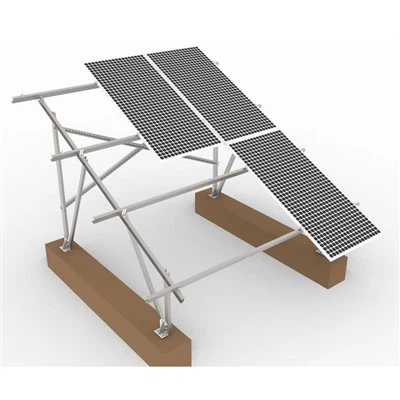
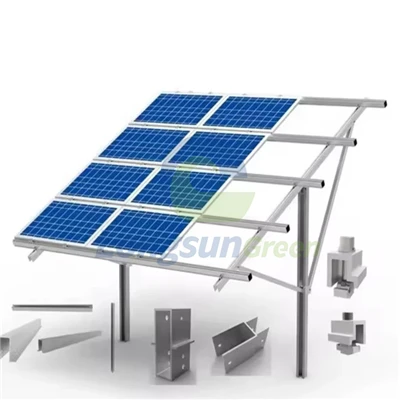
Structure: The system typically consists of:
Support Legs/Frames: Made from corrosion-resistant materials like Aluminum 6005-T5 or galvanized steel, these form the skeleton that holds the panels at the desired tilt angle (commonly 5° to 15°).
Mounting Rails: Attached to the support legs, these rails directly hold the solar panels via clamps.
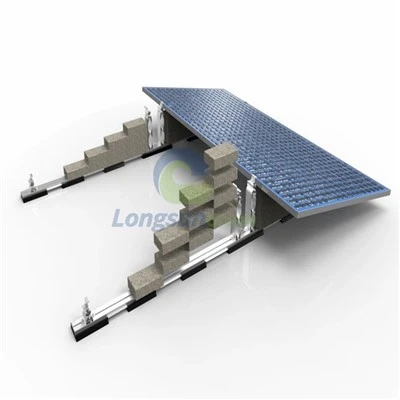
Ballast Blocks/Weights: The defining component. These are precast concrete blocks, pavers, or specialized trays filled with gravel/ballast. They are strategically placed on the mounting structure's base or within its footprint.
Principle: The system's weight, combined with the ballast, counteracts wind uplift forces. The broad base of the ballast blocks or frames increases friction with the roof surface, preventing sliding. The design is precisely engineered so that the total weight and distribution of ballast exceed the calculated maximum wind uplift for the specific project location.
2. Ideal Application Scenarios
Understanding where this system excels is key to its successful deployment.
Roof Types: Flat Concrete Roofs (most common), built-up roofs (BUR), modified bitumen, EPDM, TPO, and PVC membranes. It is crucial that the roof structure has been professionally assessed to bear the additional dead load.
Building Types:
Commercial & Industrial: Warehouses, factories, shopping malls, logistics centers – where large roof areas and preserving warranty are paramount.
Public Sector: Schools, hospitals, government buildings seeking sustainable upgrades without structural modification.
Multi-Unit Residential: Apartment buildings where obtaining individual penetration permissions is impractical.
Key Considerations:
Roof Warranty Preservation: The primary advantage. It keeps the roof membrane intact, avoiding voided manufacturer warranties.
Historical or Leasing Constraints: Ideal for buildings where drilling is prohibited (e.g., leased properties, historically significant structures).
High-Wind & Snow Regions: Modern systems are engineered to meet strict codes (e.g., ASCE 7, Eurocode) for specific site conditions.

3. Comprehensive Evaluation of Advantages
Choosing a ballasted system offers a multi-faceted value proposition:
Roof Integrity & Warranty: Eliminates the risk of leaks associated with roof penetrations, maintaining the roof's waterproofing integrity and existing warranties.
Installation Speed & Flexibility: Components are often pre-assembled. Installation requires no specialized drilling equipment or sealants, significantly reducing labor time and complexity. The system can also be relocated or expanded with relative ease.
Design Versatility: Accommodates various panel sizes, brands, and both portrait and landscape orientations. Tilt angles can be optimized for geographic location to maximize energy yield.
Reduced Long-Term Maintenance: With no penetrations, there is no need for periodic re-sealing or inspection of roof flashings, leading to lower lifecycle maintenance costs.
Environmental & Economic Efficiency: Minimizes material use (no need for complex flashings/standards) and reduces installation waste. While ballast adds weight, the overall system often proves cost-competitive when factoring in avoided roof warranty issues and faster installation.

4. Key Selection Criteria: A Buyer's Checklist
When evaluating a ballasted system like those from Longsun Green, consider these essential factors:
Structural Engineering & Certification:
Does the supplier provide site-specific wind and snow load calculations (per ASCE 7, Eurocode, or local standards)?
Are the systems certified by independent bodies (TÜV, CE, UL, etc.)?
Is the material (Aluminum alloy grade, steel coating thickness) clearly specified and suitable for your environment (e.g., coastal C5 corrosion zones)?
Ballast Design & Roof Load:
What is the calculated ballast requirement per array for your site's conditions?
Has a professional structural engineer confirmed your roof's load-bearing capacity for this added dead load?
How is the ballast secured (e.g., in trays, strapped) to prevent shifting?
System Design & Compatibility:
Does the design allow for optimal row spacing to minimize shading?
Is it compatible with your chosen panel dimensions and electrical layout?
Does it offer the desired tilt angle for energy optimization?
Manufacturer's Expertise & Support:
Can the manufacturer (e.g., Longsun Green) provide detailed CAD drawings, installation manuals, and ballast layout plans?
Do they offer custom engineering for non-standard projects?
What is the warranty period for the mounting hardware?

5. Illustrative Success Scenario
Project: A 500kW rooftop installation on a large logistics warehouse in a coastal region with high wind speeds.
Challenge: The roof had a 20-year TPO membrane warranty that could not be voided. The coastal location demanded high corrosion resistance.
Solution: Longsun Green provided a non-penetrating ballasted system using Aluminum 6005-T5 for the entire structure. Engineering analysis determined the precise ballast weight per module to withstand 140 mph wind loads. The design incorporated a 10-degree tilt for optimal energy harvest.
Outcome: The installation was completed 30% faster than a penetrating system would have allowed, with zero impact on the roof warranty. The corrosion-resistant aluminum ensures longevity in the salty air, and the owner benefits from uncomplicated roof maintenance and maximized energy production.
Conclusion
A non-penetrating ballasted solar mounting system represents a sophisticated, reliable, and roof-friendly solution for flat roof PV installations. The choice hinges on a thorough analysis of your roof's structural capacity, local climatic conditions, and long-term asset management goals. By partnering with an experienced and technically proficient manufacturer like Longsun Green, you gain access to engineered solutions that balance performance, preservation, and profitability.
For a personalized consultation and engineering assessment for your next project, contact our expert team at Longsun Green.