

A Comparative Analysis: Single-Pole vs. Dual-Pole Ground Mount Solar Structures
The selection of an appropriate mounting structure is a critical determinant in the technical feasibility, economic viability, and long-term performance of ground-mounted photovoltaic (PV) projects. This white paper provides a detailed comparative analysis of two prevalent solutions: the Single-Pole (or Central-Pole) Mount and the traditional Dual-Pole Mount. By examining their structural principles, functional mechanisms, application suitability, and total cost of ownership, this document aims to equip project developers, engineers, and EPCs with the data necessary to make an informed optimal choice for their specific site conditions and project goals.
1. Structural & Functional Principles
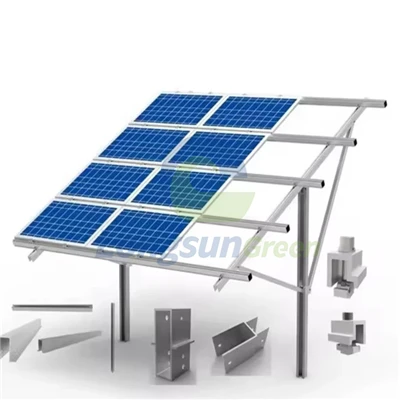
Single-Pole Ground Mount (Central Pile)
Design: This system employs a single, robust central column (or pile) driven into the ground, which supports multiple PV modules arranged in a portrait-orientation array. The modules are secured to rails that are cantilevered from a central torque tube or framework attached to the top of the pole.
Functionality: The design relies on the deep foundational strength of the central pile to resist overturning moments caused by wind and snow loads. The entire array acts as a unified structure, with the pole serving as the pivotal point. Advanced versions often incorporate a slew drive or geared mechanism at the top, enabling the entire array to rotate, thus functioning as a Single-Axis Tracker (SAT), significantly boosting energy yield.

Dual-Pole Ground Mount (Traditional Ground Mount)
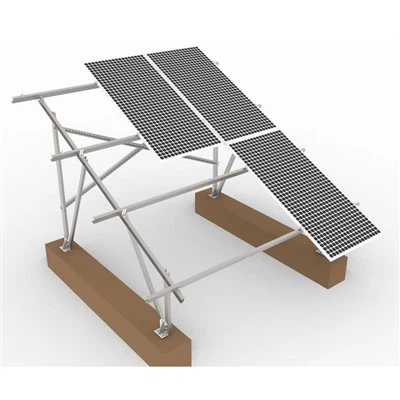
Design: This is a more conventional system consisting of two rows of vertical supports (piles) driven into the ground. Each row of piles supports the ends of the module rails, creating a series of interconnected "tables." The structure is inherently stable due to its wide, distributed foundation points.
Functionality: Loads are distributed evenly across multiple foundation points. Wind uplift and downward snow loads are transferred directly through the rails to the two parallel rows of piles. While primarily used for fixed-tilt systems, some dual-pole designs can be adapted for tracking, though this requires a more complex and costly mechanism for each row.

2. Comparative Analysis: Advantages & Limitations
| Feature | Single-Pole Mount | Dual-Pole Mount |
|---|---|---|
| Land Usage & Impact | Excellent. Minimal ground footprint reduces site disturbance and is ideal for agrivoltaics (farming underneath). Allows for easier passage of farm equipment and preserves natural drainage patterns. | Moderate. The network of piles covers more ground area, which can impede machinery and limit co-land use options. |
| Terrain Adaptability | Superior. Excels on sloped, rolling, or uneven terrain. The single pile can be driven to different exposed heights to follow the contour of the land, minimizing costly earthwork and grading. | Good, but less flexible. Requires more precise grading to ensure all pile tops are at a uniform height, often necessitating cut-and-fill operations on complex sites. |
| Installation Efficiency | Higher. Requires roughly 50% fewer piles to be driven, significantly reducing foundation installation time and labor. The centralized mounting structure can streamline subsequent assembly. | Lower. More piles and a larger number of components (clamps, braces, connections) result in a longer and more labor-intensive installation process. |
| Material & Cost Economy | Lower Material Cost. Fewer piles and reduced steel/aluminum usage lead to direct material savings. | Higher Material Cost. The greater number of components inherently increases the Bill of Materials (BOM). |
| Structural Performance | High, but centralized. Engineered to withstand significant loads, but the failure of the central pile is catastrophic. Requires rigorous geotechnical analysis for the single foundation. | Distributed & Redundant. Loads are shared across many points. The failure of a single pile is less likely to cause a cascading structural failure. |
| Tracking System Suitability | Ideal. The single pivotal point is the most efficient and cost-effective foundation for single-axis tracking systems, enabling large arrays to follow the sun. | Less Suitable. Implementing tracking requires a drive system for each row, dramatically increasing mechanical complexity, cost, and maintenance points. |
| Aesthetics & Maintenance | Clean, elevated appearance. Easier access underneath for maintenance or vegetation management. The centralized structure can present a cleaner, less cluttered look. | Industrial appearance. More components can appear visually busier. Access underneath can be more restricted due to the dense network of supports. |
3. Application Scenarios & Project Suitability
Choose Single-Pole Mount When:
Maximizing Land Use is Critical: Projects involving agrivoltaics, grazing land, or sites with high land value.
Terrain is Challenging: Hilly, sloped, or irregular sites where extensive grading is undesirable or prohibitively expensive.
High Energy Yield is the Priority: The project plan includes Single-Axis Tracking to maximize ROI through increased generation.
Project Speed is Essential: The reduced installation time accelerates the overall project timeline.
Choose Dual-Pole Mount When:
Site Conditions are Ideal: Flat, stable ground with straightforward soil conditions.
Budget is Highly Constrained (Capex Focus): While material costs may be higher, the well-understood installation process can be competitively priced, especially for smaller, fixed-tilt projects.
Extreme Wind/Snow Loads are a Primary Concern: The distributed load path can be advantageous in regions with the most severe weather, providing a perceived or calculated margin of safety.
Tracking is Not Required: For simple, fixed-tilt installations where the cost and complexity of a tracker are unjustified.

4. Case Study Snapshots
Success with Single-Pole:
Project: A 5MW community solar farm in Vermont, USA.
Challenge: Hilly terrain, requirement for sheep grazing, and a desire to minimize environmental impact.
Solution: A fixed-tilt Single-Pole system was selected.
Outcome: The system was installed with minimal land grading, preserving the landscape. The open space underneath allowed for continued grazing, creating a dual revenue stream for the landowner. The project was completed two weeks ahead of schedule due to the reduced foundation work.
Success with Dual-Pole:
Project: A 20MW utility-scale solar farm in Arizona, USA.
Challenge: Vast, flat desert land, straightforward soil conditions, and a primary focus on achieving the lowest possible Levelized Cost of Energy (LCOE) with a fixed-tilt system.
Solution: A cost-optimized Dual-Pole fixed-tilt system was deployed.
Outcome: The project leveraged economies of scale on a proven technology. The simple, robust design met all structural requirements for wind loads in the flat terrain and was constructed efficiently by a workforce highly familiar with the dual-pole "table" design.
5. Conclusion and Strategic Recommendation
The choice between Single-Pole and Dual-Pole ground mounts is not a matter of one being universally superior, but of strategic alignment with project-specific parameters.
The Single-Pole Mount represents innovation and efficiency. It is the forward-looking choice for projects prioritizing dual land use, challenging topography, and high-performance tracking. Its value proposition lies in reducing soft costs, enabling new application spaces, and maximizing energy production per acre.
The Dual-Pole Mount represents reliability and tradition. It remains a robust, well-understood solution for large-scale, fixed-tilt installations on flat, uncomplicated sites where its straightforward engineering and predictable installation process can be effectively leveraged.
Ultimately, a detailed site-specific analysis-encompassing geotechnical surveys, energy yield modeling (comparing fixed-tilt vs. tracking), and a comprehensive Levelized Cost of Energy (LCOE) calculation-is indispensable. This analysis will clearly delineate the technical and economic trade-offs, guiding stakeholders to the most profitable and resilient mounting solution for their solar asset.